
Introduction
Cities in extreme climates heat up because of how they are built — with large areas of exposed paving, limited canopy cover, and materials that absorb and re-emit heat.
The result isn’t just high air temperatures, but intense surface heat that affects how people experience outdoor space.
Urban greening is often presented as a solution. But the key question isn’t simply whether trees provide cooling to cities, it’s how they do so and under what circumstances their impact really starts to matter.
In hot-arid climates, cooling is not only about lowering air temperature; it also depends on reducing surface heat and managing radiation at the level where people walk.
This article examines cooling performance in Riyadh through climatic principles — particularly the behaviour of heat, how radiation works, and surface temperature in outdoor environments. It also includes a bioclimatic design approach that aims to create comfortable, sustainable outdoor environments by working with, rather than against, local climate conditions (sun, wind, humidity, and vegetation), supported by measured data from a parking area in Riyadh. It argues that in extreme climates, effective cooling is the result of intentional design through shade, surface control, and spatial arrangement, rather than an outcome that planting alone can deliver.
The Heat Island Problem in Riyadh
Riyadh’s urban heat is driven more by radiation than by moisture. With low humidity and minimal cloud cover, sunlight directly heats exposed surfaces, which then become a primary source of intense heat.
In peak summer conditions, exposed mineral surfaces can easily exceed 55°C. Asphalt, concrete, and compacted paving absorb solar energy throughout the day and re-radiate heat long after sunset, extending thermal discomfort into the evening hours.
In such environments, thermal comfort isn’t determined solely by air temperature. The experience of heat at pedestrian level is shaped by radiant exchange — the absorption and emission of energy between the body and surrounding surfaces.
That is why urban cooling strategies in extreme climates must address surface heating and radiation, not only air temperature moderation. Effective thermal mitigation depends on the physical design and arrangement of space, considering what is shaded, what is exposed, and how surfaces are configured, rather than on atmospheric temperature alone.
How Trees Provide Cooling Effects
Solar interception is the dominant mechanism. By filtering incoming short-wave radiation (solar energy from the sun) before it reaches the ground, canopy layers limit the heating of pavement and soil. In hot-arid conditions, this reduces the amount of energy stored in surface material and later released as long-wave radiation (heat emitted from warmed surfaces).
Sunlight reaches Earth as shortwave radiation in the form of visible light and near-infrared waves. When it strikes a surface, the energy is absorbed and converted into heat, which then warms the surrounding air.
In direct sunlight, a surface receives 800 to 1000 watts per square meter, compared to just 50 to 150 watts per square meter in shade. This means shaded surfaces receive up to ten times less solar energy.
The result is a notable temperature gap. Dark surfaces like asphalt can reach up to 80°C in direct sun light, while the same surface in shade may reach a maximum of 50°C, the difference is 30 degrees.
Empirical studies in semi-enclosed courtyards in hot-arid climates (e.g., Shashua-Bar et al., 2009) indicate that peak air temperature reductions under tree canopy are typically limited to 1–2°C. By contrast, shaded ground surfaces can exhibit substantially larger temperature differences, underscoring that the primary thermal benefit of trees lies in modifying surface energy balance rather than significantly cooling ambient air.
Evapotranspiration provides a secondary cooling effect. As water evaporates from leaf surfaces, it draws heat from the surrounding air, cooling it in the process. In dry climates, this can contribute to localised cooling, but its effectiveness is limited by how much water is available to the plant, the size of its root zone, and how well it copes under heat stress.
In hot and arid conditions, evapotranspiration plays a supporting role but is less reliable than shading as a cooling mechanism. When water is scarce or plants are under stress, this cooling effect diminishes considerably.
Both shading and evapotranspiration work together, but neither is guaranteed. A tree can only cool its surroundings effectively if it is healthy, well established, and has enough root space and water to maintain a full, dense canopy. Without these conditions, its ability to reduce heat is significantly reduced.
In extreme climates, planting becomes thermal infrastructure only when it is spatially coordinated and allowed to mature over time, meaning it actively determines how heat is absorbed, stored, and experienced.
Considering only Air Temperature Is Not Enough
The previous section explained how trees influence heat through shading and evapotranspiration, this section focuses on how cooling is typically measured, and why air temperature alone is not sufficient.
Urban heat mitigation is frequently evaluated through changes in air temperature alone. In hot-arid environments, however, this metric captures only part of the thermal condition.
Measurements from the courtyard studies mentioned earlier reveal a more critical insight: while air temperature changes remain modest, surface temperatures can drop dramatically—from ~55°C to the mid-30s—highlighting that thermal comfort is determined by radiation exchange rather than air temperature alone.
The thermal implication is significant. Even when changes in air temperature are small, surface temperatures can vary significantly, which in turn affects the amount of long-wave radiation emitted into pedestrian areas. Additionally, the human body exchanges heat not only with the air but also with nearby surfaces.
In extreme climates, the question isn’t simply how much the air cools, but how effectively radiation is interrupted at ground level, with cooling performance understood as a function of surface and spatial conditions rather than air temperature alone.
Transformed Parking Area in Riyadh
The transformation of a parking area in Riyadh provides a measurable example of spatial surface moderation within a dense urban core.
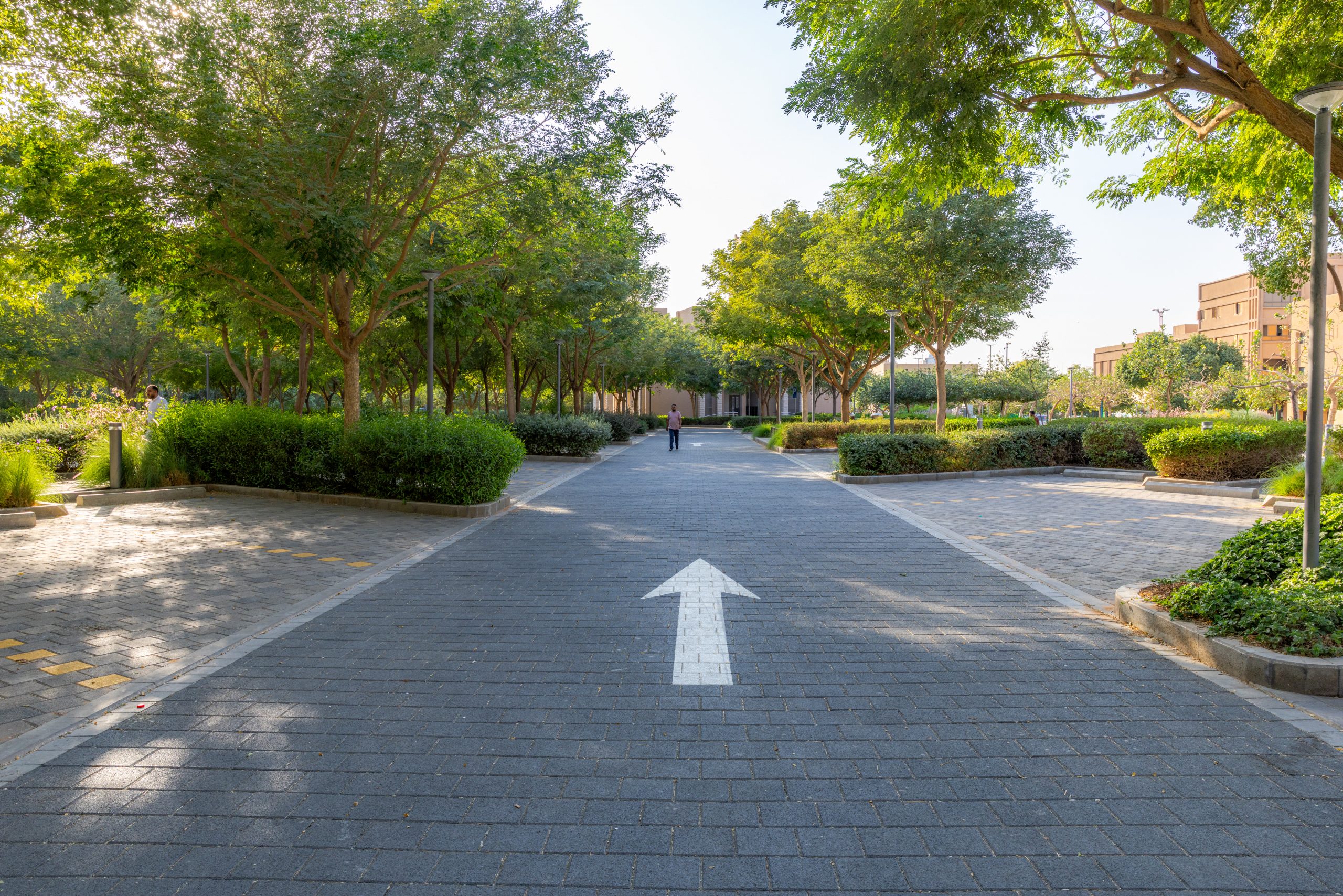
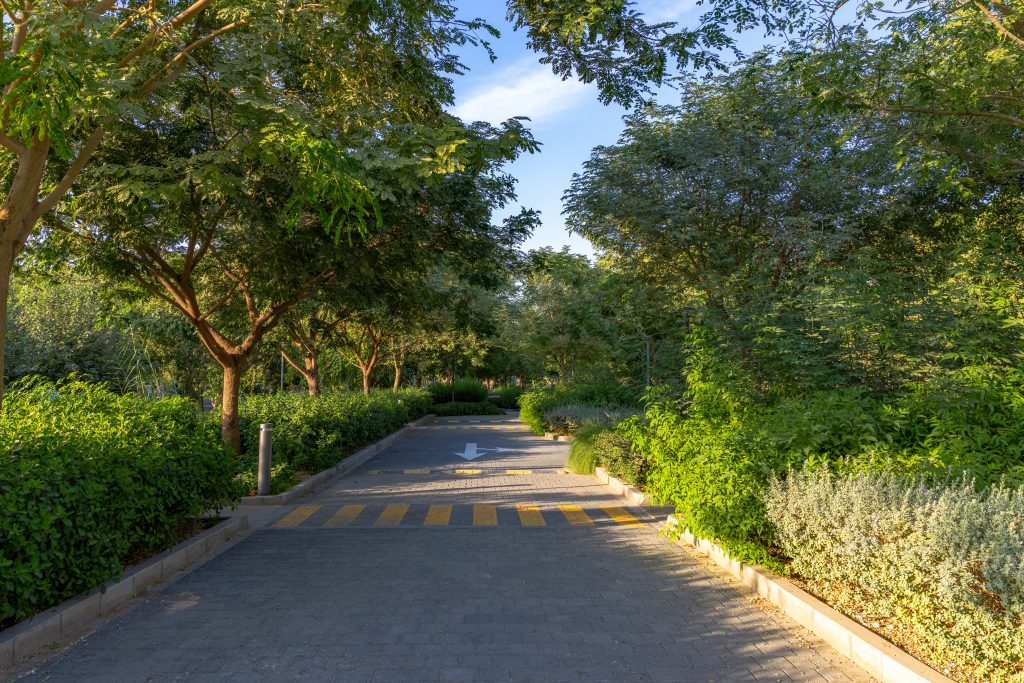
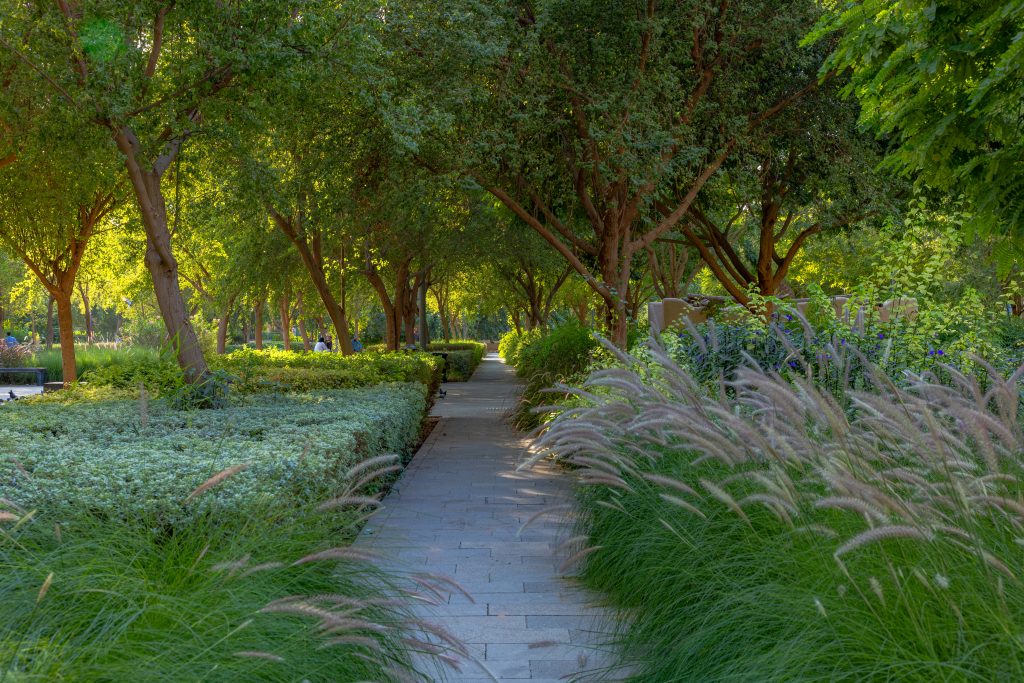
The site, 14,983 m², was previously dominated by exposed paving with limited canopy cover. In February 2023, following the planting of 187 trees across the site, canopy coverage was measured at 45%. By April 2025, as the trees matured, canopy coverage had increased to 75%, without any additional planting. The trees were positioned to align with pedestrian circulation, ensuring shade continuity along the primary movement routes.
Surface temperature measurements from 2013 reached 56°C across the site. Following canopy development, measurements taken in 2024 dropped to 49°C, with figures adjusted for annual average temperature differences between the two years.
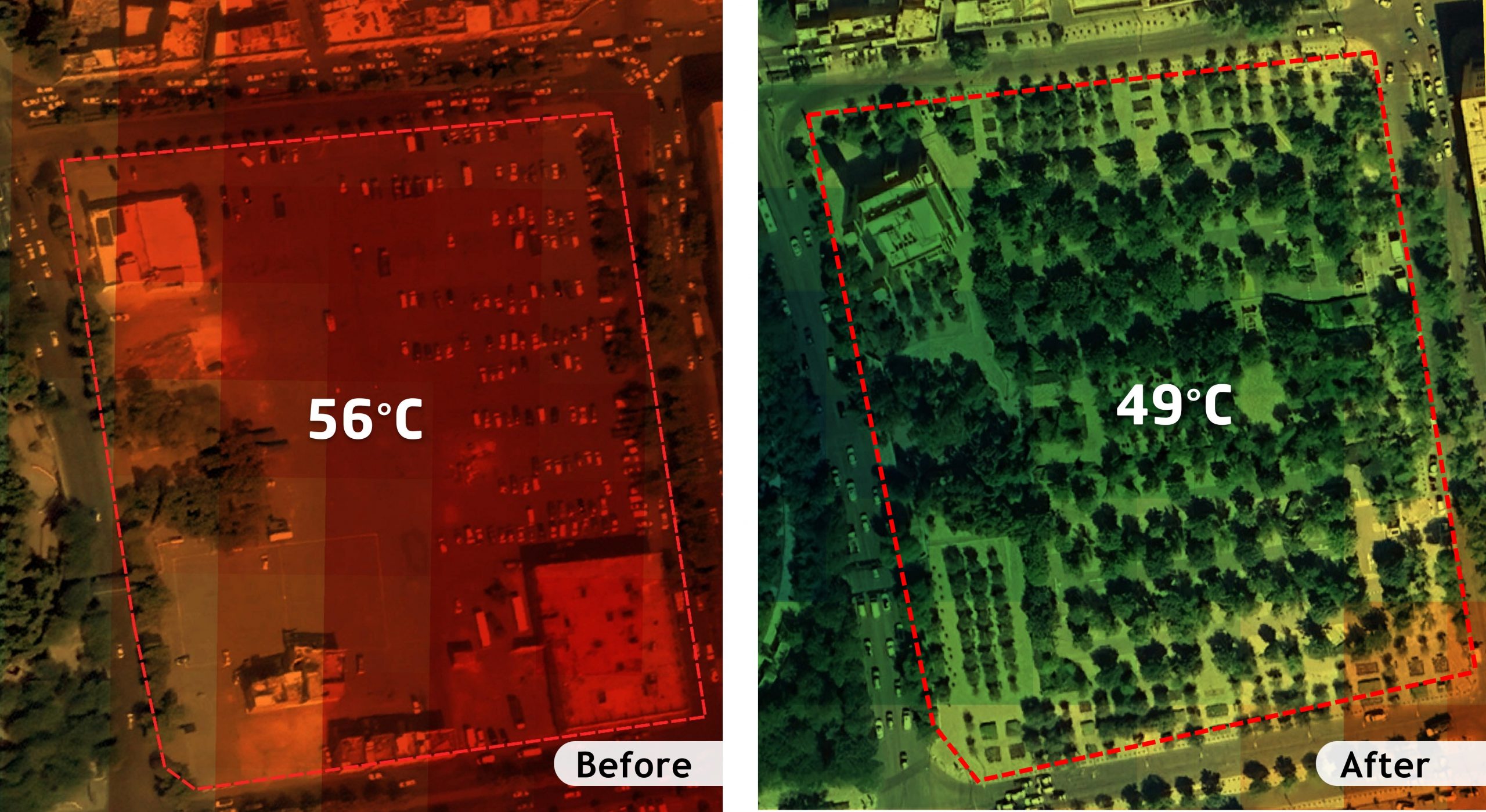
The 7°C reduction refers to surface temperature, not air temperature. In hot and arid climates, this distinction still matters because hot surfaces directly affect how people feel heat.
When the sun heats a surface like paving or asphalt, that surface releases heat back into the surrounding space. People nearby absorb this radiated heat from multiple directions, making the area feel significantly hotter than the air temperature alone would suggest. When surfaces are shaded, they absorb less sunlight and stay cooler. Cooler surfaces then release less heat into the surrounding space, making the area feel more comfortable for people.
Surfaces do not only absorb heat during the day, but they also retain it and release it gradually after sunset. In parking areas and hardscaped areas across Riyadh, this means the space remains uncomfortably hot well into the evening and night hours. Providing shade during the day directly reduces the amount of heat absorbed by surface materials, which has a measurable effect on how quickly those surfaces cool down after sunset and how comfortable the space becomes in the evening.
This particular parking area demonstrates that in extreme climates, cooling performance depends on canopy continuity, spatial arrangement, and reducing peak ground temperatures.
Design Strategies for Effective Cooling
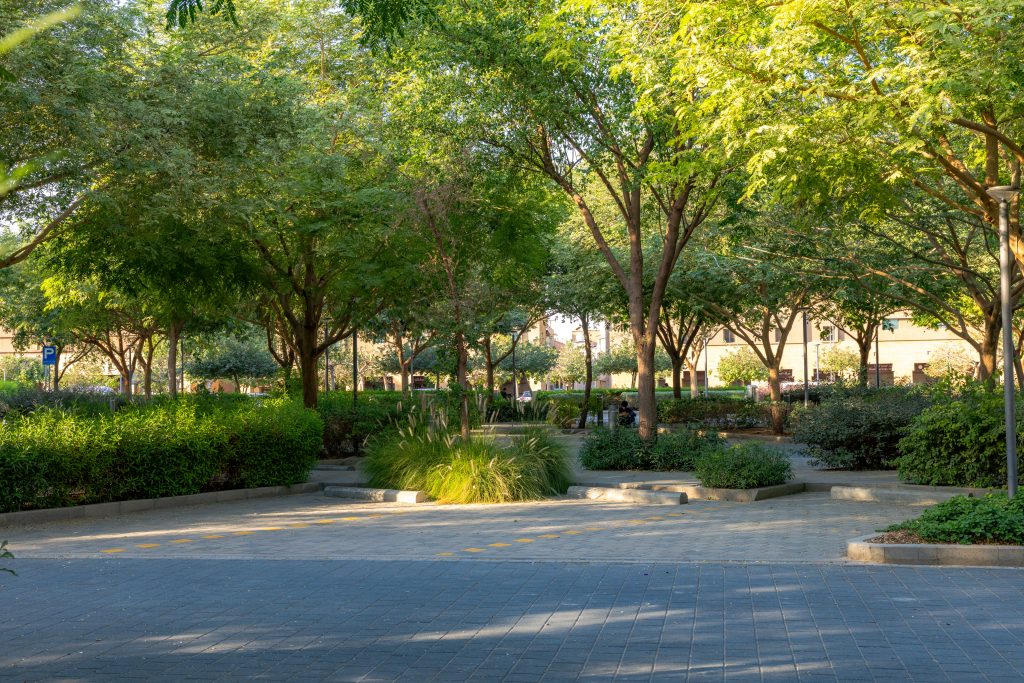
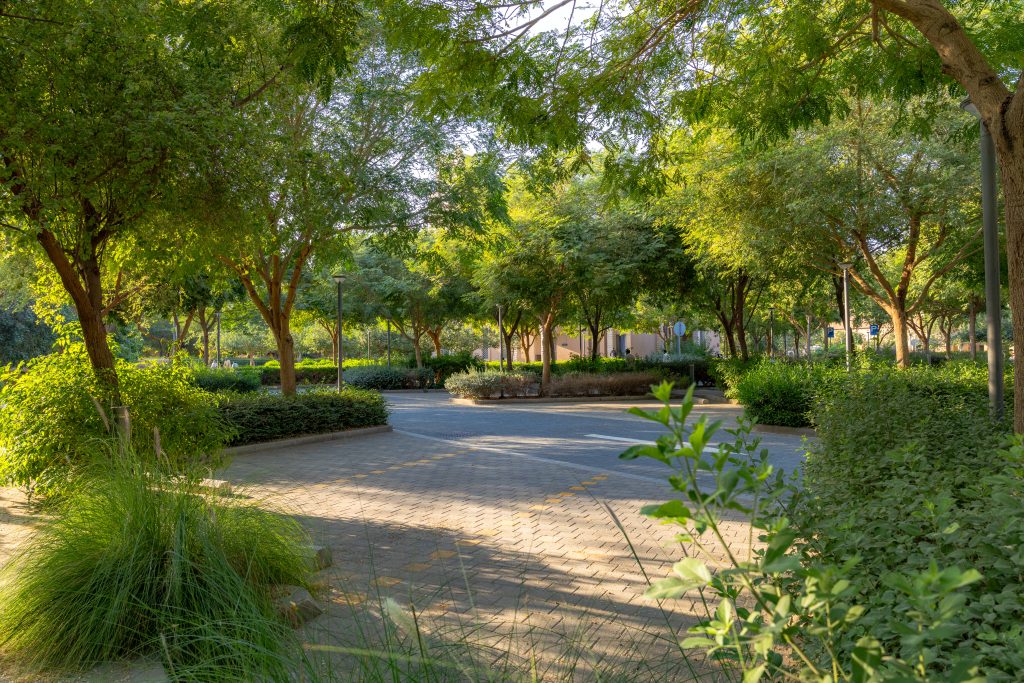
In hot-arid cities, planting alone is insufficient to cool a space effectively. Meaningful cooling requires the integration of mature vegetation, considered spatial layout, and low-absorption surface materials working in combination. When these elements are designed to work together, they produce measurable improvements in thermal comfort.
The following design principles are informed by observed surface temperature performance and canopy development and identify what is required to achieve effective cooling outcomes in extreme climate conditions.
1. Prioritize canopy continuity over isolated shade.
When trees are placed in isolation or scattered without a clear layout strategy, gaps in shade coverage inevitably occur. Arranging tree canopies in a continuous line along primary pedestrian routes ensures that the most heavily used areasremain shaded, reducing the amount of exposed surface that absorbs and radiates heat.
2. Design for surface moderation, not visual greening.
Lowering peak surface temperatures directly reduces the amount of radiant heat experienced at ground level. Tree placement should therefore be evaluated by how effectively it blocks direct solar exposure across paved and ground surfaces, rather than by how well it fills a space visually or meets a planting quota.
3. Integrate soil volume as thermal infrastructure.
Sustained canopy density requires adequate rooting depth and irrigation strategy. Withoutsufficient soil volume, trees cannot maintain the leaf area necessary to deliver long-term shading performance.
Soil volume within the tree pit alone is not a sufficient measure of whether a tree will thrive. The full volume of rootable soil available to the tree must be considered. As a general rule of thumb, a tree requires approximately 0.6 m³ of rootable soil for every 1 m² of its projected crown area. For a tree with a crown spread of 28 m², this translates to a required rootable soil volume of approximately 17 m³.
Where tree pits are small or soil volumes are restricted by surrounding structures and paving, the available rootable volume must be supplemented through alternative approaches such as structural soil cells, connected tree pit systems, or shared soil trenches between trees.
4. Allow time for canopy maturation.
The shift from 45% to 75% canopy coveragedemonstrates that cooling capacity increases as canopy density and volume increase, and shaded areas begin to overlap. Thermal mitigation improves as shade geometry evolves and surfaces experience longer daily protection from direct radiation.
5. Balance shading with airflow.
While canopy cover reduces surface heating, overly dense planting can restrict air movement. In hot climates, wind contributes to convective cooling by removing accumulated heat from surfaces and from the human body. Effective cooling design therefore considers both radiation control and the preservation of air circulation.
Cooling in extreme climates is not achieved through planting alone. It depends on the deliberate arrangement of shade, surfaces, and soil, and on creating the conditions that allow trees to mature over time — an investment in the future of our cities.
Conclusion
Why Cooling Solutions Need Thoughtful Design, Not Just Aesthetic Appeal
In hot-arid cities, thermal mitigation cannot be considered independently of resource management. Irrigation in water-scarce environments carries a significant operational cost, encompassing extraction, distribution, and long-term maintenance. Cooling strategies that depend primarily on evaporative processes, without providing adequate structural shade, risk consuming substantial water resources while delivering limited and short-lived reductions in ambient temperature.
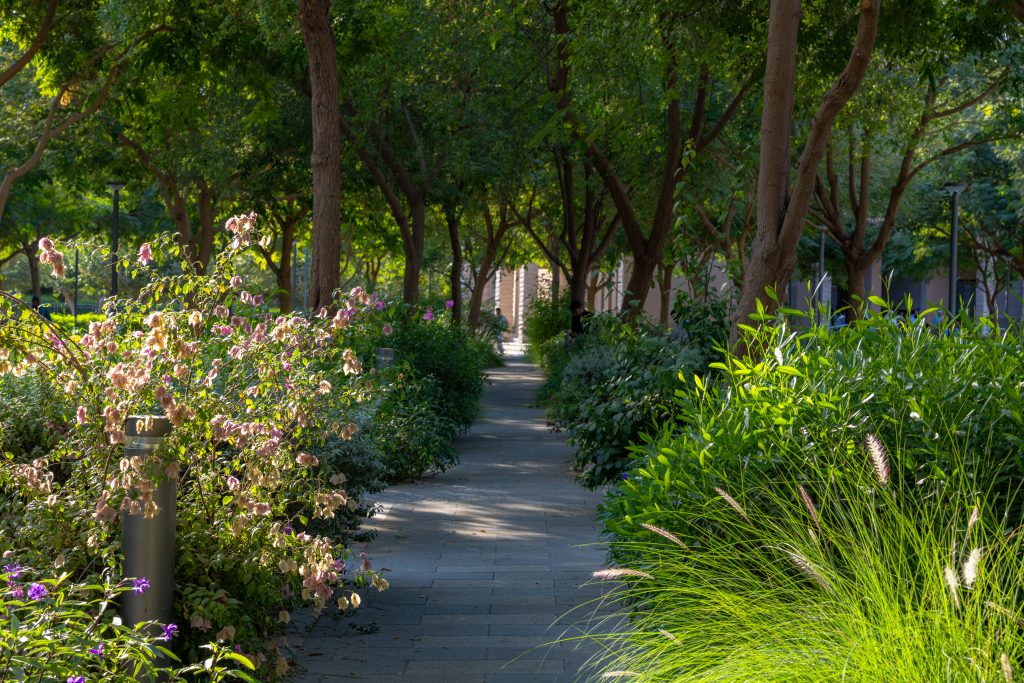
Effective cooling in extreme climates depends on a combination of continuous canopy coverage, sufficient rootable soil volume, and the deliberate reduction of exposed high-absorption surfaces. In hot-arid conditions, thermal comfort is not a product of visual planting decisions. It is the result of design that prioritises measurable performance outcomes from the outset.
References:
Shashua-Bar, L., Pearlmutter, D., & Erell, E. (2009). The cooling efficiency of urban landscape strategies in a hot dry climate. Landscape and Urban Planning, 92, 179–186.

You are currently viewing a placeholder content from Facebook. To access the actual content, click the button below. Please note that doing so will share data with third-party providers.
More Information