
The Overlooked Resource
In Saudi Arabia, planting more trees is only part of the challenge. Beneath many landscapes lies a more fundamental question: how can soils with little organic matter and limited water-holding capacity support healthy vegetation over time?
One possible answer may come from a resource that is already abundant in the Kingdom: date palm waste.
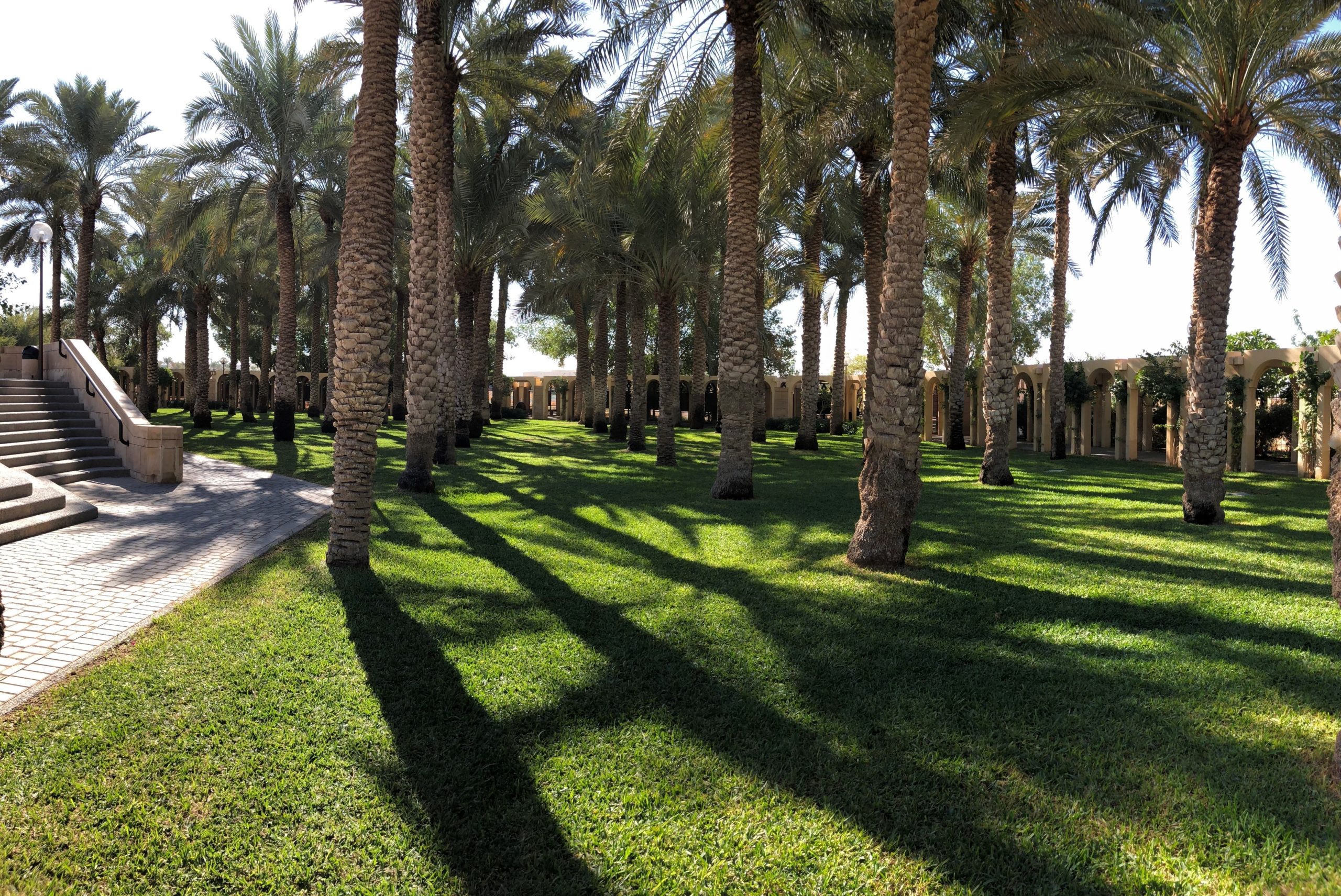
Date palms are among the most recognizable elements of the Saudi landscape. For centuries, they have provided food, shade, building materials and cultural identity. According to the General Authority for Statistics, Saudi Arabia had more than 37.6 million date palms in 2024, of which over 32 million were fruit-bearing, with date production reaching approximately 1.923 million tonnes.
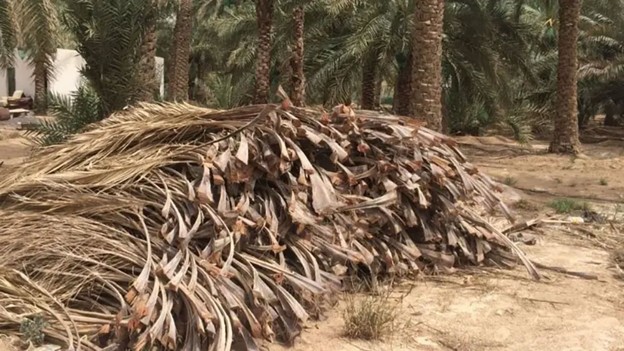
Yet these trees also generate considerable quantities of agricultural residues. Fronds are pruned, old trunks are removed, and leaves, stems and other organic materials accumulate across farms and plantations. Estimates suggest that a single date palm can produce around 20 kg of dry leaves annually. Across millions of trees, this represents a potentially substantial supply of biomass, although the quantity available for reuse depends on collection, existing uses and processing requirements.
While some residues are already reused, others are discarded or burned, representing both a waste-management challenge and a missed opportunity.
What if some of these materials could be returned to the ground, not as waste, but as resources that help restore the very soils on which Saudi landscapes depend?
The Soil Problem
Many Saudi landscapes, particularly in the central, eastern and northern regions, face difficult growing conditions. Sandy and calcareous soils often contain little organic matter, have limited capacity to retain water and nutrients, and can be affected by salinity.
In coarse sandy soils, water can move rapidly beyond the root zone, while high evaporation rates make maintaining suitable moisture conditions difficult. These challenges are particularly significant in disturbed wadis, agricultural land and urban development sites, where soil structure may have deteriorated further.
For landscape architects, the challenge is not simply how to plant more vegetation, but how to create the soil conditions that allow vegetation to establish and thrive.
Plant selection and efficient irrigation remain essential, but the performance of the soil itself is equally important. Without adequate moisture retention, nutrient availability and root development, even well-designed planting schemes can struggle to establish successfully.
This is where date palm waste begins to take on a different significance. Rather than viewing agricultural residues solely as materials to be disposed of, they could become part of a local approach to rebuilding soil quality.
Turning Waste into Biochar
One of the most promising ways to use date palm residues is by converting them into biochar.
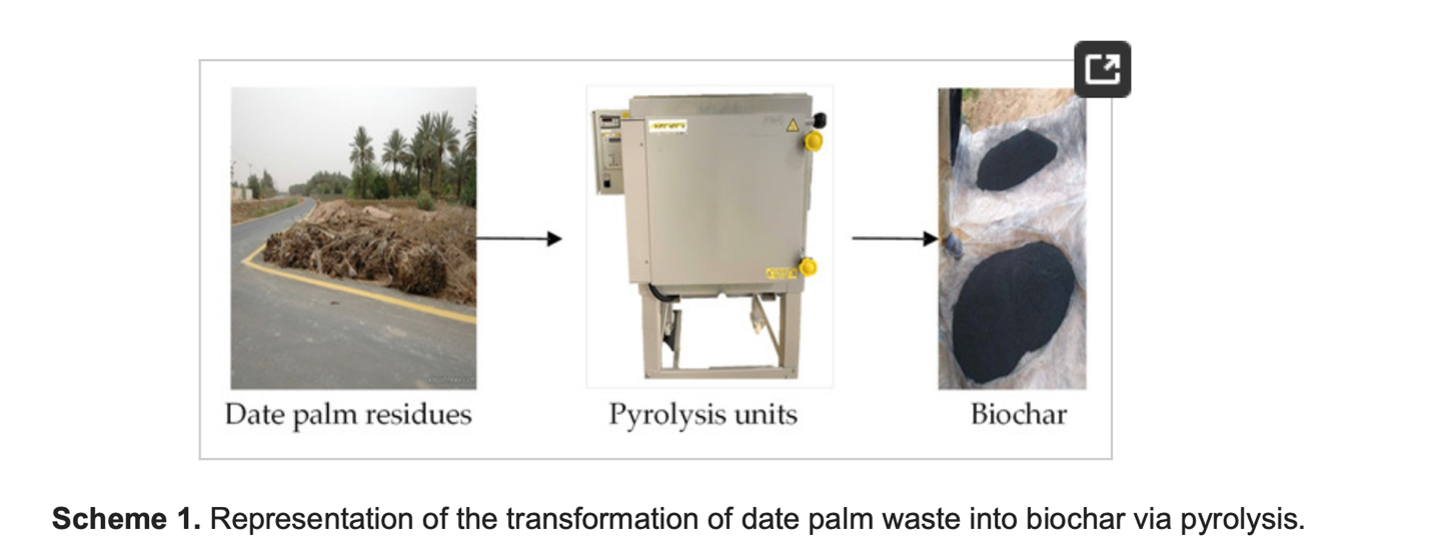
Biochar is a carbon-rich, porous material produced through pyrolysis, a process in which organic matter is heated under limited oxygen. Unlike untreated plant residues, which decompose relatively quickly, much of the carbon in biochar is more resistant to decomposition and can remain in the soil for extended periods.
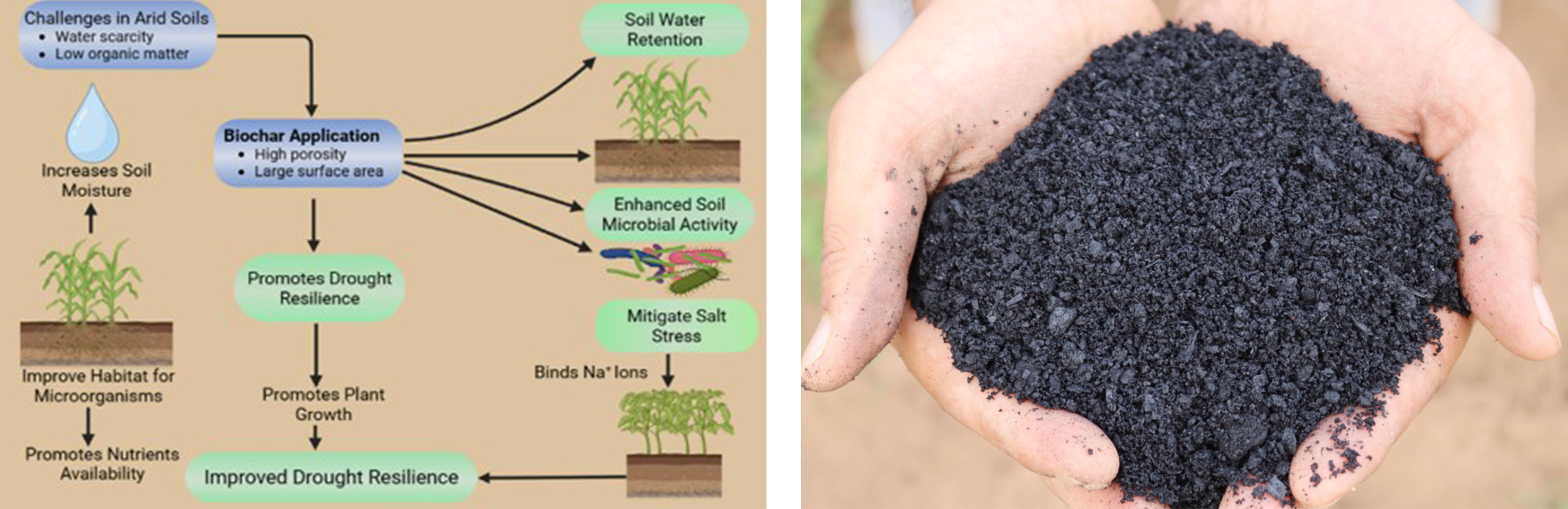
Its porous structure and surface properties can also influence how soil retains water and nutrients, creating opportunities to improve growing conditions in sandy environments.
For Saudi landscapes, where water availability is often a defining constraint, these properties are particularly relevant.
Biochar also introduces another environmental benefit. Converting suitable agricultural residues into a stable, carbon-rich material can contribute to long-term soil carbon storage. However, its overall climate benefit depends on how the material is produced, the energy required and what would otherwise have happened to the waste.
The broader opportunity is to create a local material cycle. Residues generated through date palm cultivation and maintenance could be processed into soil amendments and returned to support agricultural land, planting areas and potentially degraded landscapes.
Instead of importing all the materials needed to improve growing conditions, part of the solution could come from resources already produced within the region.
What Saudi Research Reveals
Research conducted at King Saud University provides evidence of how date palm biochar can improve the water-related properties of sandy soils.
In a 2024 study published in Sustainability, researchers examined biochar produced from date palm residues, specifically fronds and rachis, and incorporated it into sandy soil from the Riyadh region at application rates of 1%, 3% and 5% by weight.
The findings were significant.
Soil water retention increased by approximately 29.7–36.8% compared with untreated soil. In a separate measurement, the amount of water remaining at the end of the experiments increased by up to 112.29% at the 3% application rate.
Cumulative evaporation also decreased across the tested application rates, while unsaturated hydraulic conductivity was reduced, indicating that the movement of water through the soil had changed.
The researchers found that production temperature and particle size influenced performance. Finely ground biochar, particularly particles measuring 0.5–1 mm and produced at relatively low pyrolysis temperatures of around 300°C, performed well in improving the hydrological properties of sandy soil.
These findings are directly relevant to landscape practice. Improving soil water retention could help maintain moisture within planting zones and potentially reduce some of the water losses associated with coarse sandy soils.
However, the research was conducted through controlled soil-column experiments. It did not directly measure irrigation savings, vegetation survival or long-term performance in completed landscape projects.
Further field testing is therefore needed to establish whether similar improvements can be achieved under Saudi planting conditions, where soil characteristics, irrigation water quality, plant species and seasonal temperatures vary considerably.
Nevertheless, the findings provide a scientific foundation for investigating date palm biochar as a locally produced soil amendment.
A Local Alternative to Imported Growing Media
The potential of date palm waste extends beyond biochar.
Peat moss is widely used in horticultural growing media because of its ability to retain moisture and support plant establishment. However, peat is extracted from peatlands, ecosystems that take thousands of years to develop and store enormous quantities of carbon.
Draining and extracting peat can damage these ecosystems and release stored carbon, prompting growing interest in alternative materials.
For Saudi Arabia, where peat is imported, the opportunity to develop growing media from locally available agricultural residues is particularly relevant.
Different forms of processed date palm waste can serve different purposes. Fibers derived from fronds may contribute to the physical structure and aeration of growing media. Composted date palm residues can provide organic matter and nutrients, while biochar may improve moisture and nutrient retention and introduce more persistent carbon into the soil.
Research has already examined the use of composted date palm waste as a substitute for peat moss, with promising results under controlled growing conditions. More recent investigations have also explored processed palm-based fibers as alternatives to imported horticultural substrates.
These materials are not interchangeable, and their performance depends on how they are processed and combined.
For example, biochar can vary considerably in pH, salinity and water-retention properties, while poorly processed organic residues may affect nutrient availability or plant growth. Testing is therefore essential before incorporating these materials into planting specifications.
The opportunity is not necessarily to replace peat entirely with one product, but to develop locally produced growing-media blends suited to Saudi soil conditions and landscape requirements.
Compared with relying exclusively on imported amendments, this approach could create new uses for agricultural waste while encouraging a more locally grounded material supply.
From Research to Landscape Restoration
For landscape architects, the importance of this research lies in how it could influence the design and long-term performance of planted landscapes.
In urban parks, streetscapes and public spaces, soil conditions play a major role in determining whether vegetation establishes successfully. Where soils have limited water-holding capacity, amendments such as biochar could be investigated as part of planting-soil mixtures designed to improve moisture retention while maintaining adequate drainage and root aeration.
In degraded wadi landscapes, the potential is equally interesting. Disturbed soils may struggle to support vegetation because of poor structure, erosion and irregular water availability. Locally produced amendments could become part of restoration strategies aimed at improving growing conditions, although their effects on infiltration, soil stability and floodwater movement would need careful assessment.
For native and climate-adapted planting, soil improvement may help support establishment during the early stages of growth. Even species adapted to arid environments require suitable conditions for their roots to develop before they can tolerate prolonged environmental stress.
The application of date palm biochar is not a complete solution to these challenges. Its performance depends on the receiving soil, the characteristics of the biochar, irrigation practices and the needs of the plants.
It also raises practical questions for landscape implementation. What application rates are appropriate for different soil types? How should the material be incorporated into planting areas? How does it perform with saline irrigation water? And could improved soil conditions translate into measurable reductions in irrigation demand and better plant establishment over several growing seasons?
Answering these questions will require field trials that compare amended and untreated soils under similar conditions.
Monitoring soil moisture, salinity, plant growth, survival and irrigation requirements would help determine whether the benefits observed in laboratory research can be translated into practical landscape applications.
Such evidence would allow landscape architects to move beyond the general promise of biochar and toward informed material selection and specification.
A Resource Already Within the Landscape
Saudi Arabia has already begun exploring the value of date palm waste on a national scale.
In September 2024, the National Center for Palms and Dates and the Ministry of Environment, Water and Agriculture announced a palm-waste biochar initiative intended to improve agricultural soil conditions and reduce water consumption. The initiative projected water savings of 30% for participating agricultural applications, although such results should not be assumed for other soil types or landscape settings without further testing.
Similar approaches are being investigated internationally. Rice husks, olive residues and sugarcane bagasse have been converted into biochar and other soil amendments, demonstrating how agricultural by-products can become useful resources rather than materials for disposal.
The significance for Saudi Arabia is that date palm residues are already part of the landscape’s existing material cycle.
The same trees that provide shade, food and cultural identity also generate organic materials that could contribute to soil improvement. With suitable processing and testing, some of these residues could be returned to agricultural land, nurseries and restoration projects to support healthier growing conditions.
This does not eliminate the need for careful soil management, appropriate planting design or efficient irrigation. Nor does it mean that every form of date palm waste is suitable for direct application to soil.
What it offers is an opportunity to reconsider the relationship between landscapes and the materials they generate.
As Saudi Arabia continues to expand its urban green spaces and ecological restoration efforts, attention must extend beyond the number of trees planted to the quality of the soils that support them.
The long-term success of these landscapes will depend on their ability to retain water, sustain vegetation and function under demanding environmental conditions.
Date palm waste may not provide the entire solution, but it offers a promising starting point: transforming locally available agricultural residues into materials that could help restore Saudi Arabia’s soils and support more resilient landscapes.

You are currently viewing a placeholder content from Facebook. To access the actual content, click the button below. Please note that doing so will share data with third-party providers.
More Information