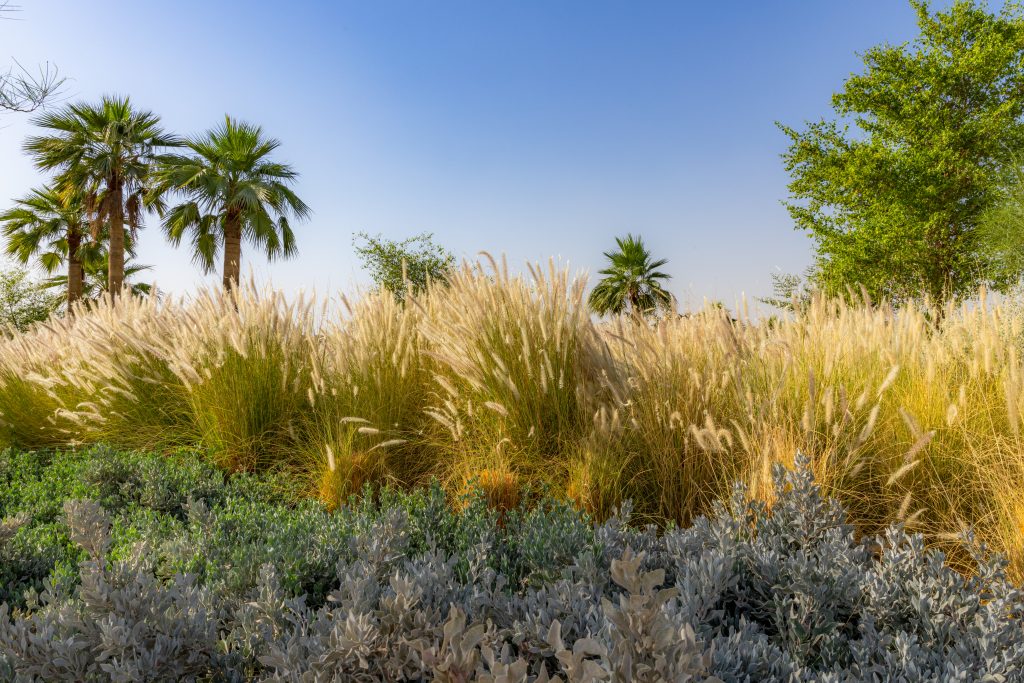
How KFCC Uses Planting to Shape Ecology, Culture, and Identity
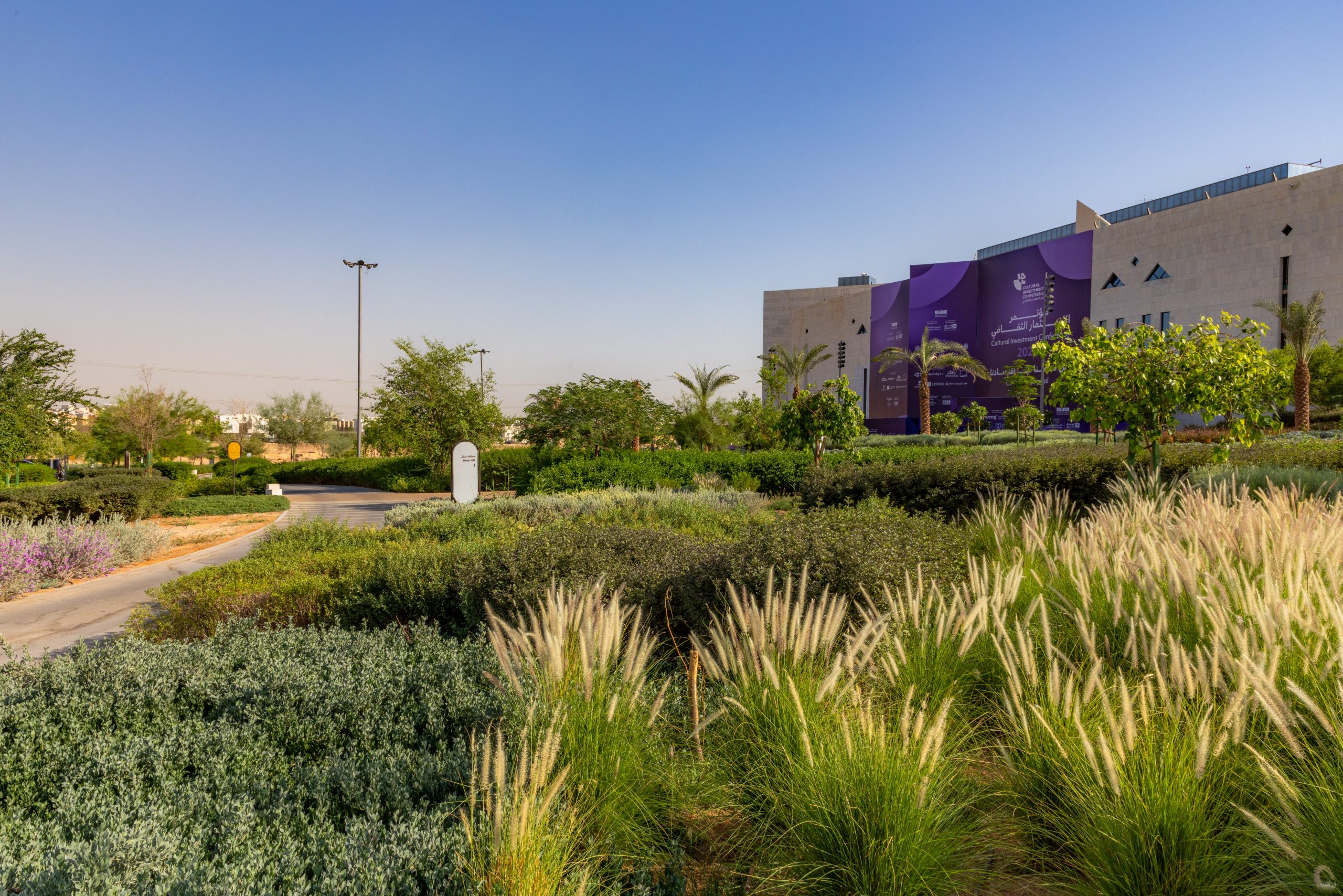
Native, low-water planting at KFCC, chosen to thrive with minimal irrigation.
Context
At KFCC, water limitations shaped every planting decision. Irrigation was minimised due to these constraints, and a diverse palette of native and climate-adaptive vegetation was used to attract fauna while reinforcing sustainability. Avoiding monocultural plantings further supported a stable community of species and helped the site blend naturally with its surroundings.
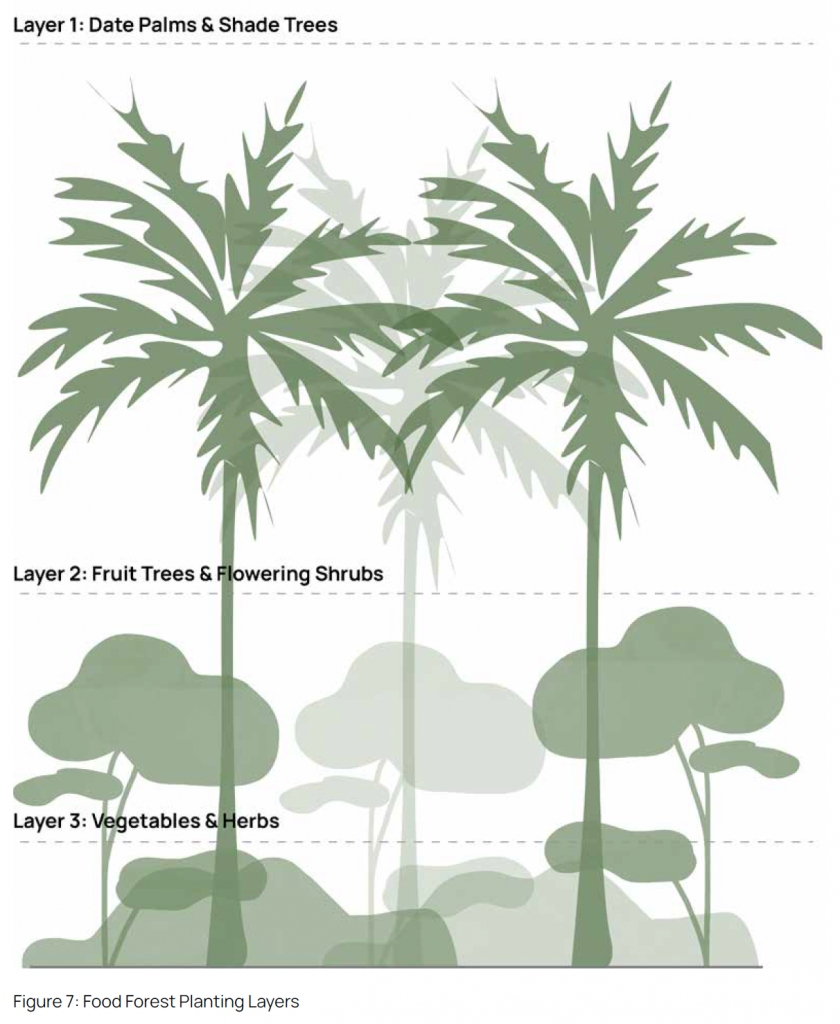
Historical planting principles also informed the design, particularly the multi-layered planting of traditional oasis gardens and palm groves. In these systems, three vertical layers maximize every drop of water:
Palms and fruiting shade trees above,
Shrubs and small fruit trees beneath
And vegetables and herbs close to the ground.
Graphic from 2nd edition of Manual of Arriyadh Plants.
This approach created microclimates rich in shade and humidity, a small paradise in a desert environment.
By referencing these principles, KFCC’s planting links innovation with memory, celebrating sustainable traditions rooted in Saudi heritage.The use of native plants and historical planting principles also connects to ethnobotany, the study of the relationship between people, plants, and culture.At KFCC, ethnobotany becomes design: native species, traditional methods, and local knowledge converge to create a modern cultural experience.
To honor the country’s traditions, King Fahad Cultural Center extends these ancient principles of architecture and agriculture into a contemporary public space, one that feels both rooted and forward- looking.
Solution
The planting choices made at KFCC echo a broader shift happening across Saudi cities, where landscape is increasingly understood through ecology, culture, and identity.
Although developed for FIFA World Cup 2034 host cities, the hybrid planting model proposed by Al-Hagla and Al-Sulbi (2025) offers a useful lens through which KFCC’s planting strategy can be understood on a smaller scale. The model blends ecology, culture, and aesthetics through three connected layers:
Ecological backbone:Native species such asToothbrush tree(Salvadora persica),Sidr(Ziziphus spina-christi), different native Acacia species stabilize soils, support pollinators, and create micro-habitats.
Adaptive layer:Regionally adapted plants such assiris or Broome raintree (Albizia lebbeck), andTexas ranger(Leucophyllum frutescens), Brittlebush(Encelia farinosa),Desert myrtle(Limoniastrum monopetalum), andGlossy shower tree(Senna surattensis) extend resilience while carrying cultural narratives shared across the Gulf.
Aesthetic focal points:Carefully chosen ornamentals, Crimson fountain grass(Cenchrus setaceus‘Rubrum’),Peacock flower(Caesalpinia pulcherrima), andHottentot fig(Carpobrotus edulis), provide moments of emphasis at entrances and gathering spaces without undermining sustainability.
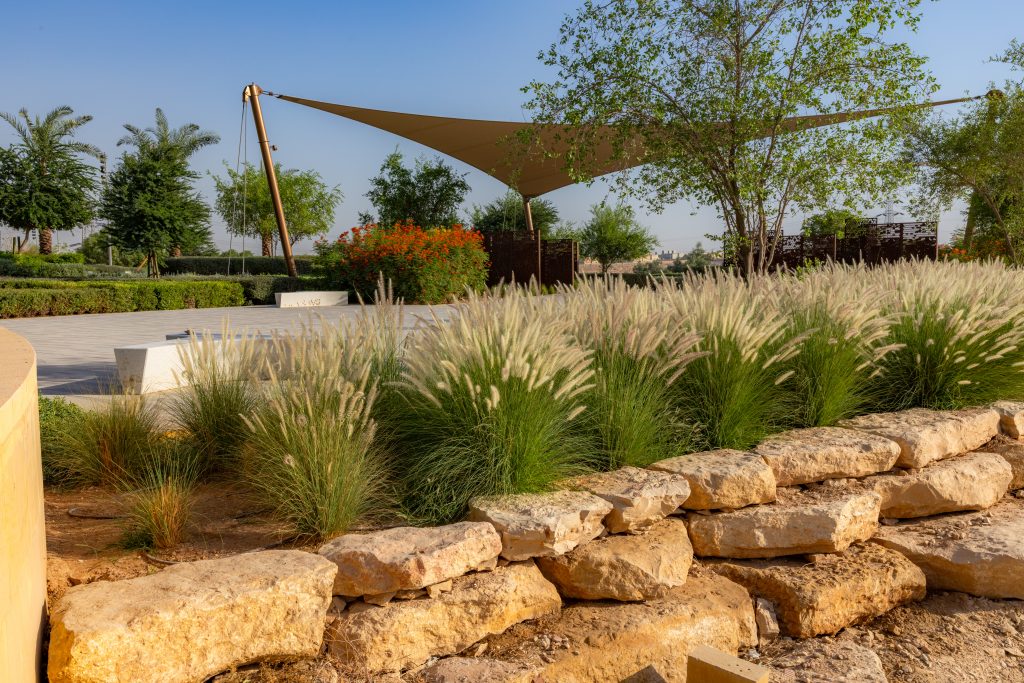
A shaded gathering space within KFCC's landscape design.
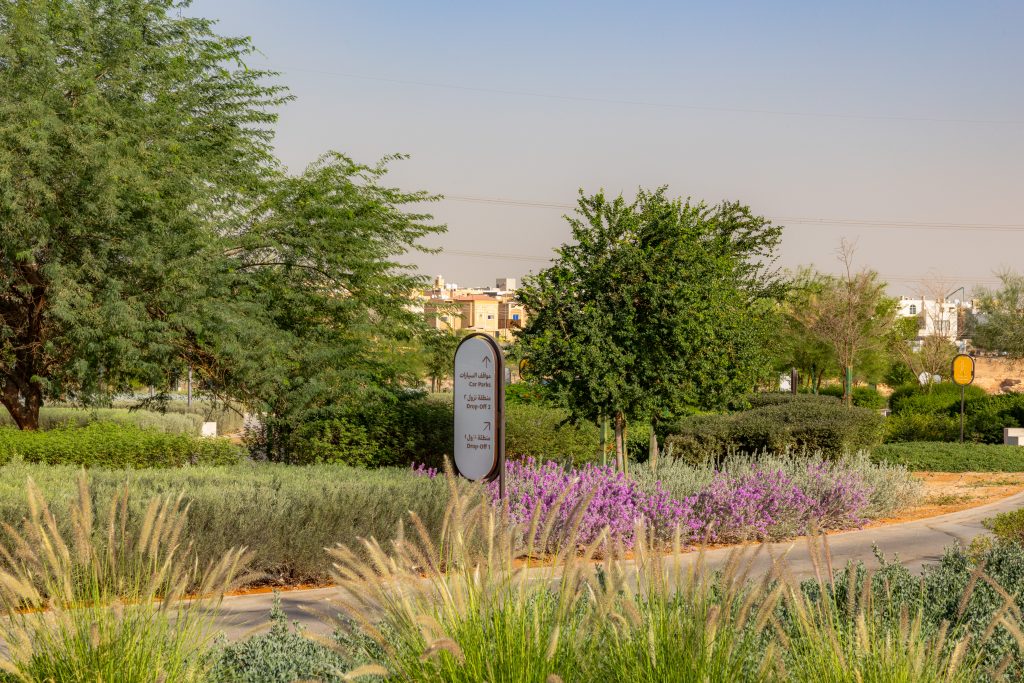
Planting along one of KFCC's arrival routes.
At KFCC, these principles come to life in the site’s quiet transitions, where gravel dissolves into groundcover, where curbs soften into sand, and where planting complements the architecture.
Impact
The result is a landscape that performs on multiple levels:
Ecological: Native and adapted plants use little water, support pollinators, and show the seasons through their flowering patterns; making the landscape feel alive and dynamic.
Cultural: The planting connects to local memory and materials, helping KFCC act not just as a cultural venue, but as a reflection of its place and heritage.
Identity and Recognition: As global precedents such as Sydney Olympic Park, Expo 2020 Dubai, and Gardens by the Bay show, landscapes that integrate ecology, culture, and aesthetics contribute directly to city identity and branding rather than serving as mere aesthetic backdrops (Al-Hagla & Al-Sulbi, 2025).
KFCC reflects how such global frameworks can be translated into a Riyadh-specific context, positioning planting as performative infrastructure for ecology, culture, and identity.
You are currently viewing a placeholder content from Facebook. To access the actual content, click the button below. Please note that doing so will share data with third-party providers.