
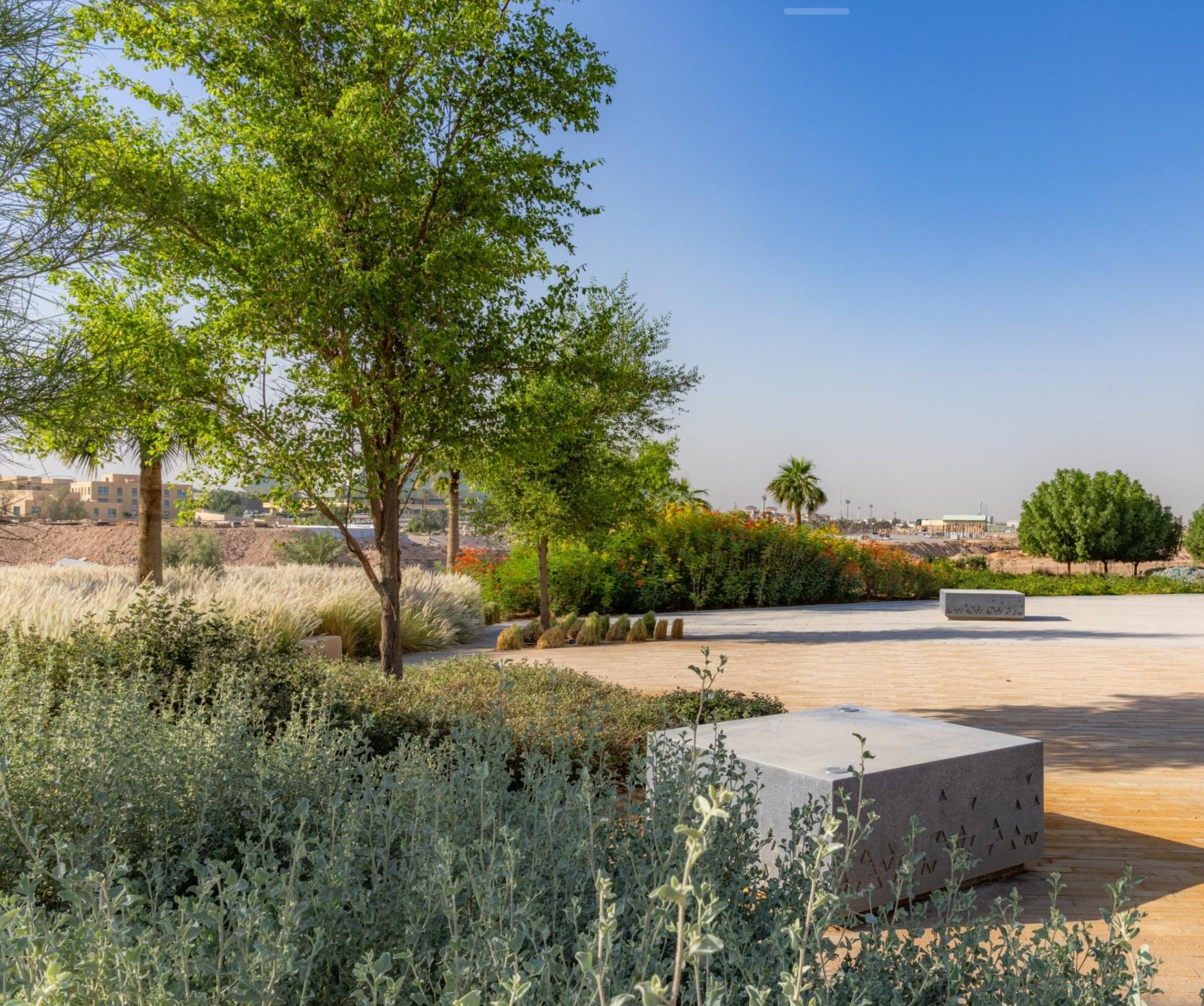
Megaprojects in Saudi Arabia and greening programs across the Middle East are reshaping desert cities at a global scale. What succeeds here informs urban resilience strategies from the Mediterranean Basin to South Asia. In this landscape, every tree planting and every irrigation cycle becomes a test of endurance—and a lesson in how to build cities that thrive in arid climates.
Breaking Rock, Building Roots
In places like Riyadh, planting often begins not with soil but with stone. Consolidated rock runs deep, and excavation requires heavy equipment to fracture it. The challenge is not how far down to dig, but how to create a planting medium that matches the scale of the tree above. A simple strategy helps us understand: for every meter of expected canopy radius, a tree needs one cubic meter of planting medium. Depth of the pit should match the root ball, and if excavation goes deeper, the base must be rebuilt with compacted soil to keep the tree stable.
Engineering the Underground
Native rock need not be replaced. On-site crushers and sieves turn fractured stone into gravel and coarse sand, which can be blended with soil amendments to create backfill. This has the added benefit of reducing carbon footprint and improving sustainability by minimizing imported materials. Using no more than one part amendment to two parts native material encourages plants to adapt to local conditions. Drainage layers of crushed rock can be added if excess water must escape, though in most cases proper irrigation is the better solution.
When Water Goes Too Far
Water is the most precious resource in Saudi landscapes, yet it is also the most common reason trees fail. Overwatering suffocates roots, disrupts drying cycles, and leaves trees vulnerable to disease. The solution is not more water, but smarter water. Healthy landscapes drink in rhythm with the desert: allowing soil to dry between waterings encourages resilience. Reducing water waste also lowers CO2 emissions by cutting energy use for pumping and desalination.
Deep watering is the practice of delivering moisture slowly, through low-flow drip emitters, over a long cycle of several hours—low and slow. This allows water to penetrate the deepest root zone rather than becoming wasted surface runoff. Roots respond by growing downward, anchoring the tree and increasing drought resilience.
Timing watering just before sunrise minimizes evaporation and maximizes absorption.
Scheduling water cycles for the desert environment helps prevent overwatering. Established desert natives thrive on deep watering once every one to two weeks in summer and three to six weeks in winter; moderate water-use species need more frequent cycles of once per week in summer and two to four weeks in cooler months; high-demand ornamentals may need irrigation every few days in peak heat. Younger plants need more frequent water while getting established.
Designing with Hydrozones
Hydrozoning organizes the rhythm of watering in the landscape. High water-use zones are placed where people gather—entrances, plazas, shaded seating—where lush vegetation enhances comfort. Surrounding them are moderate water-use zones that provide transition and cohesion. Beyond lies the majority of the landscape—low water-use zones planted with natives and drought-tolerant species, requiring minimal irrigation. This layered approach balances human needs with ecological responsibility.
Lessons from Tradition
Saudi Arabia’s landscapes can also draw inspiration from ancient practices. The Nabataeans, who once thrived in hyper-arid regions, mastered desert irrigation through terraces, cisterns, and channels that captured flash floods and stored water safely. Their systems slowed runoff and maintained agriculture. They bring wisdom that informs design across dry regions to meet sustainability targets.
Clay pitcher irrigation, or “olla,” offers a timeless lesson. Porous vessels buried near roots release water only when the soil starts to dry, conserving water and preventing overwatering. Modern adaptations such as SLECI (Self-regulating, Low Energy, Clay-based Irrigation) emitters are being tested across the region. While not ideal for zones that require drying cycles, they are offering promise in gardens and orchards where consistent moisture is desirable.
Towards an Arabian Landscape Ethic
Saudi Arabia’s greening programs demand not only aesthetic transformation but ecological responsibility. By combining engineered planting pits, precision irrigation, and respect for natural moisture cycles, designers can create resilient landscapes that thrive in desert conditions. Drawing inspiration from clay pitcher traditions roots modern practice in the wisdom of the past.
The desert teaches patience, restraint, and respect for water.
In Saudi Arabia, these lessons are not optional—they are the blueprint for landscapes that endure. Bödeker’s decades of experience creating enduring landscapes in the Arabian Peninsula brings this wisdom to every project.
When Water Goes Too Far
Water is the most precious resource in Saudi landscapes, yet it is also the most common reason trees fail. Overwatering suffocates roots, disrupts drying cycles, and leaves trees vulnerable to disease. The solution is not more water, but smarter water. Healthy landscapes drink in rhythm with the desert: allowing soil to dry between waterings encourages resilience. Reducing water waste also lowers CO2 emissions by cutting energy use for pumping and desalination.
Deep watering is the practice of delivering moisture slowly, through low-flow drip emitters, over a long cycle of several hours—low and slow. This allows water to penetrate the deepest root zone rather than becoming wasted surface runoff. Roots respond by growing downward, anchoring the tree and increasing drought resilience.
Timing watering just before sunrise minimizes evaporation and maximizes absorption.
Scheduling water cycles for the desert environment helps prevent overwatering. Established desert natives thrive on deep watering once every one to two weeks in summer and three to six weeks in winter; moderate water-use species need more frequent cycles of once per week in summer and two to four weeks in cooler months; high-demand ornamentals may need irrigation every few days in peak heat. Younger plants need more frequent water while getting established.
Designing with Hydrozones
Hydrozoning organizes the rhythm of watering in the landscape. High water-use zones are placed where people gather—entrances, plazas, shaded seating—where lush vegetation enhances comfort. Surrounding them are moderate water-use zones that provide transition and cohesion. Beyond lies the majority of the landscape—low water-use zones planted with natives and drought-tolerant species, requiring minimal irrigation. This layered approach balances human needs with ecological responsibility.
Lessons from Tradition
Saudi Arabia’s landscapes can also draw inspiration from ancient practices. The Nabataeans, who once thrived in hyper-arid regions, mastered desert irrigation through terraces, cisterns, and channels that captured flash floods and stored water safely. Their systems slowed runoff and maintained agriculture. They bring wisdom that informs design across dry regions to meet sustainability targets.
Clay pitcher irrigation, or “olla,” offers a timeless lesson. Porous vessels buried near roots release water only when the soil starts to dry, conserving water and preventing overwatering. Modern adaptations such as SLECI (Self-regulating, Low Energy, Clay-based Irrigation) emitters are being tested across the region. While not ideal for zones that require drying cycles, they are offering promise in gardens and orchards where consistent moisture is desirable.
Towards an Arabian Landscape Ethic
Saudi Arabia’s greening programs demand not only aesthetic transformation but ecological responsibility. By combining engineered planting pits, precision irrigation, and respect for natural moisture cycles, designers can create resilient landscapes that thrive in desert conditions. Drawing inspiration from clay pitcher traditions roots modern practice in the wisdom of the past.
The desert teaches patience, restraint, and respect for water.
In Saudi Arabia, these lessons are not optional—they are the blueprint for landscapes that endure. Bödeker’s decades of experience creating enduring landscapes in the Arabian Peninsula brings this wisdom to every project.
You are currently viewing a placeholder content from Facebook. To access the actual content, click the button below. Please note that doing so will share data with third-party providers.
More Information